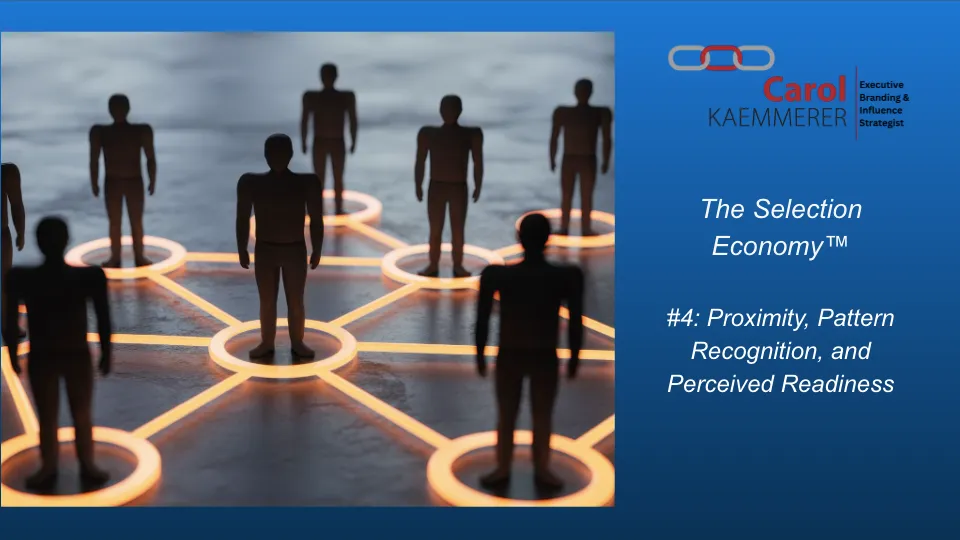
4. Proximity, Pattern Recognition, and Perceived Readiness
At senior levels, selection rarely begins with a blank slate. It begins with a short list, and that list is often shaped long before any formal process begins.
Leaders often assume that when an opportunity opens, decision-makers will step back, assess all available talent, and choose the most qualified candidate. In reality, something far more human happens. Decision-makers start with who comes to mind, and that initial recall is not random. It is shaped by three powerful forces: proximity, pattern recognition, and perceived readiness.
Proximity is not about physical distance. It is about relational and cognitive closeness. Who has been in the room? Who has contributed to important discussions? Who has been visible in moments that matter? Leaders who are in closer proximity to decision-makers, through meetings, projects, or trusted relationships, are more likely to be considered early. Their work is more familiar, their thinking is more accessible, and their presence is easier to recall. This does not guarantee selection, but it often determines who enters the conversation in the first place.
Once a leader is under consideration, pattern recognition takes over. Decision-makers do not evaluate from scratch. They compare what they see against patterns they already trust: leaders who have operated at enterprise scale, led transformation, or demonstrated broad organizational impact. These patterns are efficient, but they can also be limiting. If your visible experience does not align with a familiar pattern, decision-makers may hesitate, even when your capability is strong. One leader fits a recognized pattern. Another requires interpretation. And in high-stakes decisions, familiarity often feels safer than potential.
Perceived readiness is the final filter. Proximity may bring you into the conversation, and pattern recognition may shape how you are understood, but perceived readiness determines whether you are chosen. This is where everything converges into a single judgment: can this leader step into the role and succeed now? Perceived readiness is not a comprehensive evaluation. It is a confidence threshold. It reflects whether decision-makers feel assured enough to place a bet on you under current conditions. If your experience has not been visible in high-ambiguity, high-impact situations, they may hesitate to project you into the future demands of the role.
A Familiar Scenario
Maria had been delivering exceptional results for years. She led a high-performing division, consistently exceeded targets, and was known for her ability to execute with precision. When a senior enterprise role opened, she assumed her track record would place her in strong consideration.
But Maria had spent most of her time focused within her division. She had limited exposure to cross-functional leadership forums and few relationships at the executive level. While her work was respected, it was not widely visible outside her immediate sphere.
In succession discussions, her name surfaced briefly. But leaders who had been part of enterprise initiatives, and whose thinking had been heard in broader forums, surfaced more quickly. Leaders who fit a familiar pattern of operating at that level.
Yes, Maria was capable.
But she was not proximate. She was not patterned. And as a result, she was not perceived as ready.
This is how the three forces reinforce one another. Proximity increases exposure. Exposure reinforces patterns. Patterns shape perceived readiness. Leaders who are consistently visible in the right contexts are more likely to be recognized, more easily categorized, and more confidently selected. Leaders who are less visible must overcome all three forces at once. They must first be remembered, then interpreted, then trusted. That is a much steeper path.
For leaders aiming at senior roles, this means the question is not simply whether you are performing well. It is also whether you are visible in the places that shape opportunity, whether others associate you with the patterns that signal next-level leadership, and whether your experience is being interpreted as relevant to what comes next. These are not political questions. They are strategic ones.
👉 This week’s #littlelinkedinlesson micro-action:
Identify one opportunity to increase your proximity to broader leadership conversations. This could be contributing to a cross-functional initiative, sharing insight in a strategic forum, or making your thinking visible beyond your immediate team.
The goal is not visibility for its own sake. It is to ensure that when decisions are being shaped, you are already part of the mental shortlist.
Maria’s performance was never the question. Her proximity, pattern, and perceived readiness were.
In the Selection Economy™, leaders are not chosen from the entire field. They are chosen from those who are already in view, already understood, and already trusted. The question is not simply whether you are ready. It is whether readiness is being recognized in the moments that matter.
Afterword:
If this perspective on proximity and perceived readiness resonates, we’ll be taking the conversation further in an upcoming LinkedIn Live.
I’ll be joined by my colleague Sayre Darling as we explore what it means to build visible authority in today’s Selection Economy™—and why managing your reputation is no longer enough.
If you’re ready to think more intentionally about how you are seen, interpreted, and chosen, we invite you to join us.
April 30 • 9:00 am CT • Stop Managing Your Reputation — and Start Leading It
Register: https://www.linkedin.com/events/7450694479671615488?viewAsMember=true