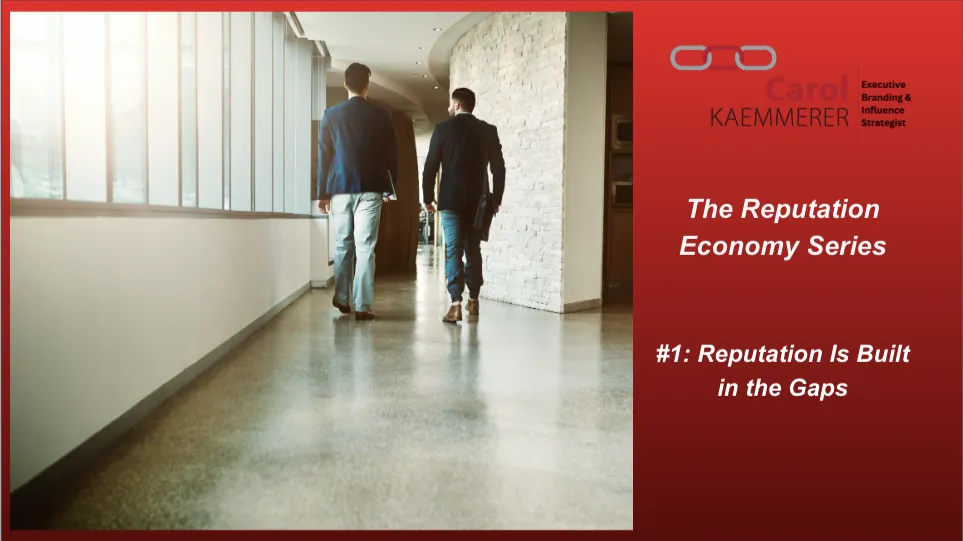
1. Reputation Is Built in the Gaps
What happens when performance reviews end and informal judgment begins?
Most senior leaders assume reputation is earned through results.
Revenue delivered. Teams stabilized. Crises navigated.
All true, and incomplete.
At the executive level, formal evaluation eventually gives way to informal judgment. The conversations that matter most no longer happen in performance reviews or interview panels. They happen in side comments, private texts, and quiet exchanges that begin with:
“Here’s how they show up.”
“Here’s what it’s like to be in a room with them.”
“Here’s what I noticed when no one was paying attention.”
This is the reputation economy at work.
When leaders are being considered for C-suite roles, board seats, or advisory positions, everything becomes a signal. Not because decision-makers are petty, but because the stakes are high and risk tolerance is low.
They are no longer asking, Can this person do the job?
They are asking, Can this person lead with judgment, steadiness, and grace when conditions are ambiguous, political, or changing fast?
That assessment is formed in the gaps.
How you carry yourself in informal settings.
How you listen when you’re not the focal point.
How you handle disagreement over a meal or in a hallway conversation.
How consistently your words, presence, and priorities align.
Lack of congruence rarely triggers feedback. It triggers quiet disqualification.
And here is the uncomfortable truth most leaders never hear: by the time opportunity is on the table, your reputation has already been decided.
👉 This week’s #littlelinkedinlesson micro-action
Conduct a Gap Audit.
Choose one recent setting where you were not formally evaluated, a meeting you did not lead, a group conversation, a networking moment, or an online exchange.
Ask yourself:
- What signal might I have sent about how I lead when I am not in charge?
- Did my presence reinforce consistency, or introduce friction?
- Would someone describing me afterward say “strong performer,” or “trusted leader”?
You are not looking to correct behavior. You are learning to see yourself as decision-makers already do.
That awareness is where reputation management actually begins.
Afterword
If reputation is built in the gaps, then your everyday interactions matter more than you think.
On LinkedIn, one of the most visible “in-between” moments is how you comment.
A well-crafted comment signals judgment, composure, and discernment. A careless one signals the opposite.
I created a short guide titled "Comment Like a Leader: The Art of Visible Engagement." It outlines how to contribute in ways that elevate your presence rather than dilute it.
You can access it here: 👉 http://carolkaemmerer.com/download-comment-like-a-leader
Because in the reputation economy, even small signals compound.